
What is the difference between Canadian and American maple syrup?
Whether you are feeding your family, your restaurant customers, or yourself, maple syrup is one of the best sweeteners nature has given us – from the perspective of both taste and health.
However, which one should you buy when faced with a choice between Canadian and American maple syrup?
In this article, you’ll get a breakdown of maple syrup from both sides of the border in North America. From production and grading to flavour and purity; here’s everything you need to know.
What is Canadian maple syrup?
Production
Producing over 70% of the world’s entire supply, we can accurately describe Canada as the ‘Home of Maple Syrup’. Within Canada, the state of Quebec accounts for the largest volume of produce.
The maple syrup production process involves the tapping of maple trees to collect sap. The sap is then boiled down to a rich syrup.
It’s a process that begins in early spring when maple trees are tapped to collect sap, which is then boiled down into a rich, golden syrup. It takes about 40 litres of sap to produce one litre of pure maple syrup.
Quality and standards
The Canadian Food Inspection Agency enforces mandatory national standards that every producer must meet.
Strict regulations are applied to everything from density and purity to labelling and packaging. For example, there must be no additives of any kind to the concentrated sap, and the syrup must be concentrated to a minimum density of 66%.
This translates to consumer confidence – when you buy Canadian maple syrup, you’re buying a product held to a consistently high, government-backed standard.
Grading system
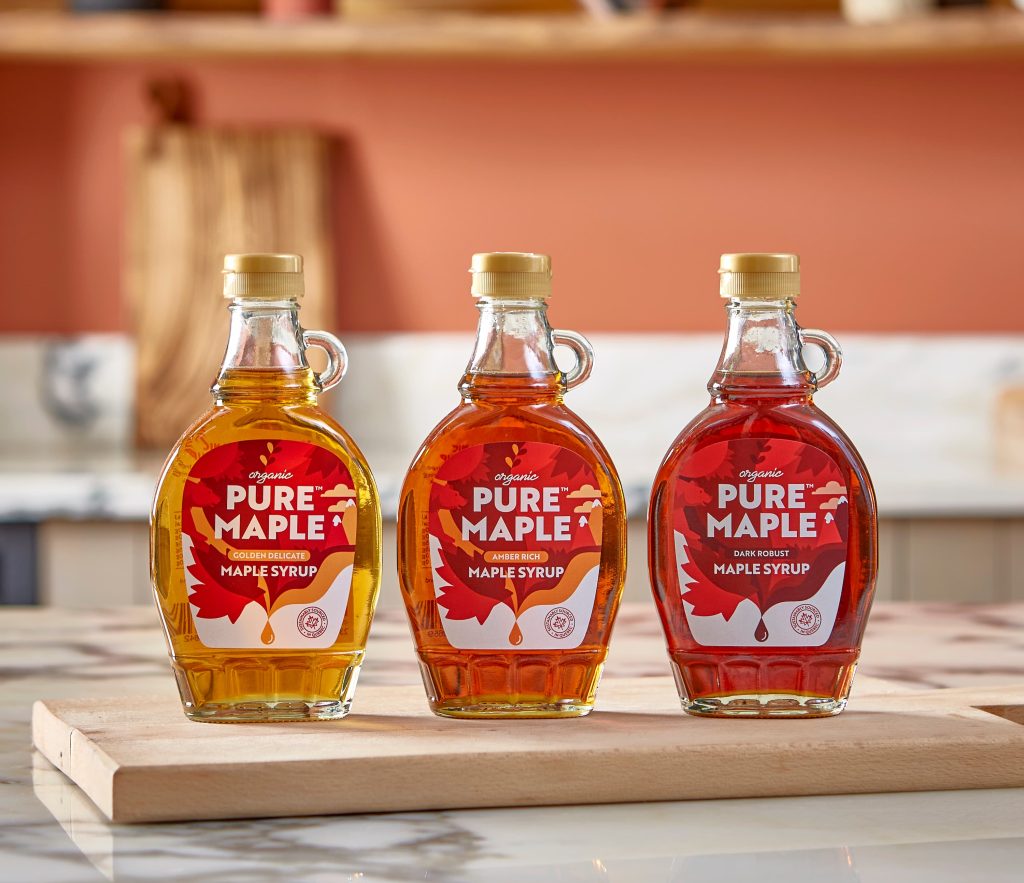
Canada uses the international Grade A grading system. This categorises syrup into Golden, Amber, Dark and Very Dark.
The different categories aren’t just different in colour. They also vary in flavour intensity and harvest period. Lighter syrups tend to have a more delicate taste, while darker grades offer more robust flavour.
Usage
Canadian maple syrup is known for its versatility in the kitchen. It’s a favourite for pancakes and waffles, but it also makes all the difference as a sweetener in baking, marinades, salad dressings, porridge oats and hot drinks. For those who are trying to cut down on refined sugar, it is a delicious, natural alternative.
What is American maple syrup?
Production
The United States is concentrated in the Northeast of the country; specifically the states of Vermont, New York and Maine. Of these states, Vermont – where maple tree harvesting is rooted in the culture – is the most acclaimed. There, smaller artisanal producers have a good reputation for their distinctive syrups.
Quality and standards
The US has its own quality standards for maple syrup, but they vary between states. In Vermont, there is a minimum sugar density of 66.9%. The general North American standard is 66%.
Grading system
Like Canada, the US now uses the same international Grade A system, with the same categories of Golden, Amber, Dark, and Very Dark. The US changed to the international grading system in 2015, which makes comparison easier for all.
Usage
American maple syrup is used in similar ways to the Canadian product, as residents of both countries enjoy the syrup as a sweetener, flavour-enhancing ingredient, and topping.
Real vs artificial
It’s worth noting that in the US, there is a sizable market for artificial maple-flavoured syrups.
These products contain very small amounts of genuine maple syrup – if at all, and are typically made from corn syrup with flavourings. If you want to purchase 100% maple syrup, be sure to check the ingredients on the product label.
Key similarities and differences
To conclude, we should underline that both Canada and the US require pure maple syrup to be made from 100% boiled maple sap with no additives, no artificial flavours.
Both countries share the same grading system, but Canada’s regulations are generally stricter and more widely enforced across the country. This means for a consistent, premium, pure and sustainably produced maple syrup, Canadian maple syrup can be seen as the gold standard.
